Animations illustrating the genetic code as a Frobenius algebra on the p4rakernel
Diagrams & Animations
01
B₄ Nucleotide Lattice
Belnap FOUR as the genetic nucleotide alphabet — the 4-valued distributive lattice underlying the genetic code. G (Both) at top, A (False) at bottom, C (True) and U (Neither) at intermediate positions.
02
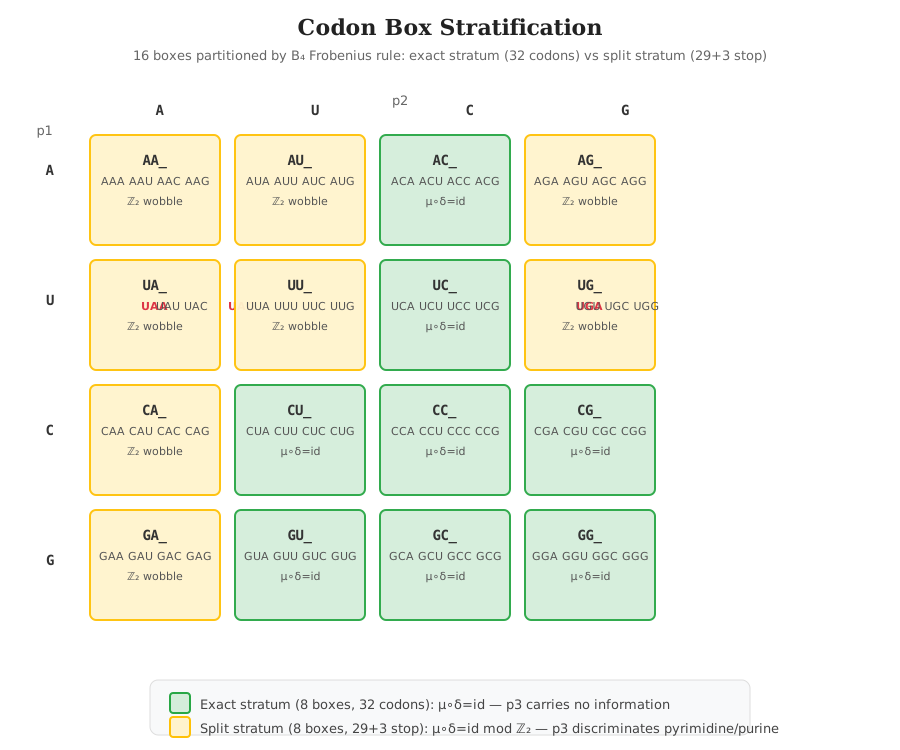
Codon Box Stratification
The 16 codon boxes partitioned by the B₄ Frobenius rule. 8 exact boxes (μ∘δ=id holds exactly, 32 codons, p₃ carries no information) vs 8 split boxes (29 codons + 3 stops, μ∘δ=id modulo ℤ₂ wobble).
03
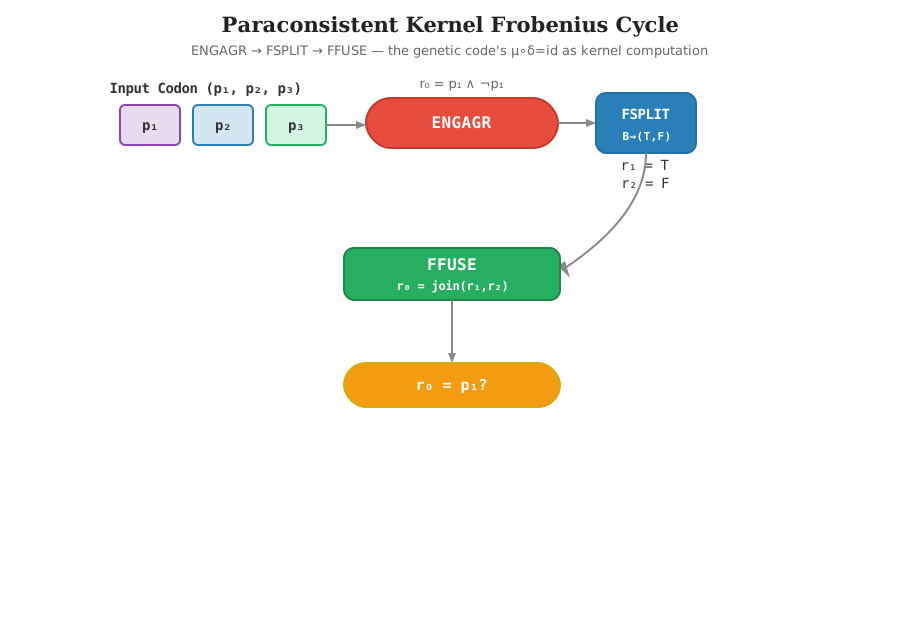
ENGAGR → FSPLIT → FFUSE Cycle
The paraconsistent kernel's Frobenius computation. Each codon undergoes the triple operation: ENGAGR (self-reference), FSPLIT (δ comultiplication), FFUSE (μ multiplication). The theorem ffuse∘fsplit = id IS the genetic code's μ∘δ=id.
04
The 20 Amino Acids: 8 Ground + 12 Promoted
Ground-layer AAs (Leu, Pro, Arg, Thr, Ala, Ser, Val, Gly) carry no primitive activation. 12 promoted AAs biject onto the 12 IG primitives (Ð, þ, Ř, Φ, ƒ, Ç, Γ, ɢ, ⊙, Ŧ, Σ, Ω), ordered by structural risk class.
05
Stop Codons as Ω Winding Boundary
UAA (Ω₀ Ochre), UAG (Ωℤ₂ Amber), UGA (Ωℤ Opal) form the Frobenius algebra's topological boundary. Each carries a distinct Ω winding class, detected by the kernel as a paradox in the Frobenius condition.
06
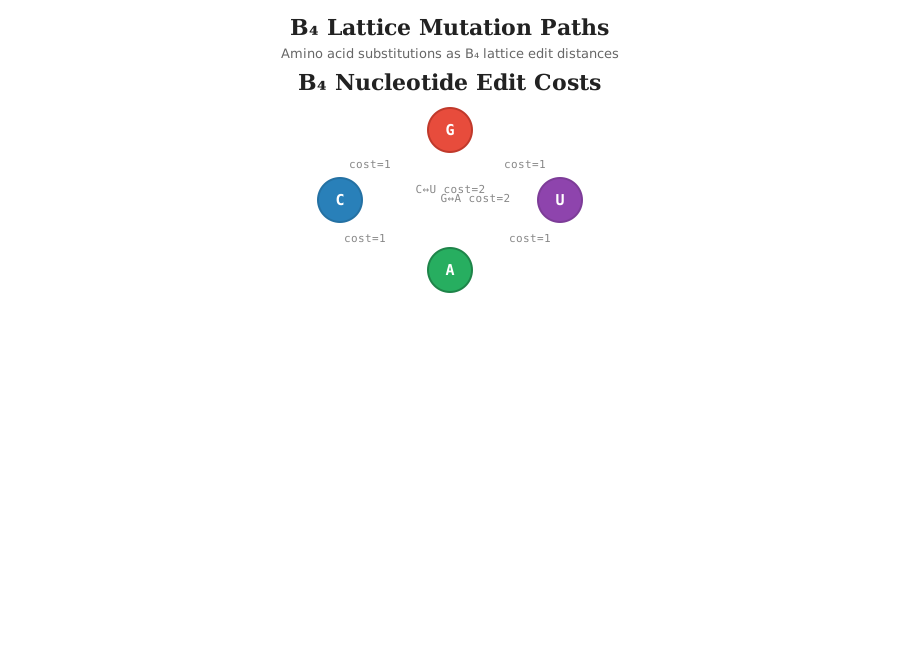
B₄ Lattice Mutation Paths
Amino acid substitutions analyzed as B₄ edit distances on the nucleotide lattice. Covering relations cost 1 (G→C, G→U, C→A, U→A). Cross-lattice jumps cost 2 (G↔A, C↔U). The Chimera Theorem governs composite edits across multiple primitive classes.