p4rakernel · Frobenius Algebra · B₄ Logic

Paraconsistent Genetics

Animations illustrating the genetic code as a Frobenius algebra on the p4rakernel

Diagrams & Animations
01

B₄ Nucleotide Lattice

Belnap FOUR as the genetic nucleotide alphabet — the 4-valued distributive lattice underlying the genetic code. G (Both) at top, A (False) at bottom, C (True) and U (Neither) at intermediate positions.
B4 Nucleotide Lattice Belnap FOUR as the genetic nucleotide alphabet cover cover G Both Guanine C True Cytosine U Neither Uracil A False Adenine Lattice structure: B (G) at top / covers C and U / C and U cover A (F) at bottom B4 meet = information intersection / B4 join = information union Watson-Crick complement (A↔U, G↔C) is NOT Belnap negation (which fixes B and N)
02

Codon Box Stratification

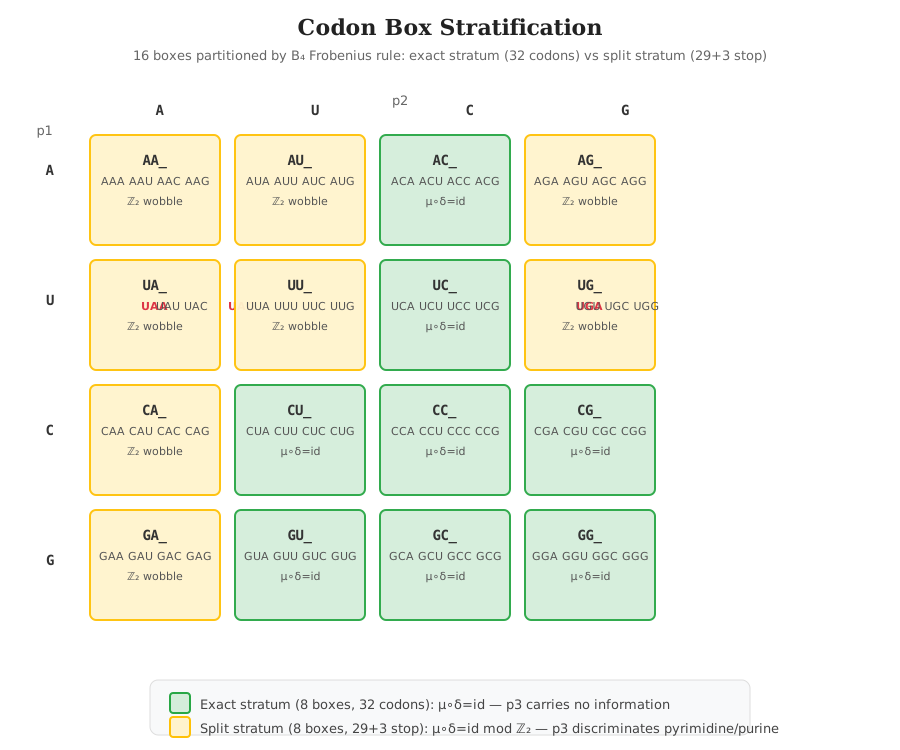
The 16 codon boxes partitioned by the B₄ Frobenius rule. 8 exact boxes (μ∘δ=id holds exactly, 32 codons, p₃ carries no information) vs 8 split boxes (29 codons + 3 stops, μ∘δ=id modulo ℤ₂ wobble).

Codon Box Stratification 16 boxes partitioned by B₄ Frobenius rule: exact stratum (32 codons) vs split stratum (29+3 stop) A U C G p1 A U C G p2 AA_ AAA AAU AAC AAG ℤ₂ wobble AU_ AUA AUU AUC AUG ℤ₂ wobble AC_ ACA ACU ACC ACG μ∘δ=id AG_ AGA AGU AGC AGG ℤ₂ wobble UA_ UAA UAU UAC UAG ℤ₂ wobble UU_ UUA UUU UUC UUG ℤ₂ wobble UC_ UCA UCU UCC UCG μ∘δ=id UG_ UGA UGU UGC UGG ℤ₂ wobble CA_ CAA CAU CAC CAG ℤ₂ wobble CU_ CUA CUU CUC CUG μ∘δ=id CC_ CCA CCU CCC CCG μ∘δ=id CG_ CGA CGU CGC CGG μ∘δ=id GA_ GAA GAU GAC GAG ℤ₂ wobble GU_ GUA GUU GUC GUG μ∘δ=id GC_ GCA GCU GCC GCG μ∘δ=id GG_ GGA GGU GGC GGG μ∘δ=id Exact stratum (8 boxes, 32 codons): μ∘δ=id holds exactly — p3 carries no information Split stratum (8 boxes, 29 codons + 3 stops): μ∘δ=id modulo ℤ₂ wobble — p3 must discriminate pyrimidine/purine
03

ENGAGR → FSPLIT → FFUSE Cycle

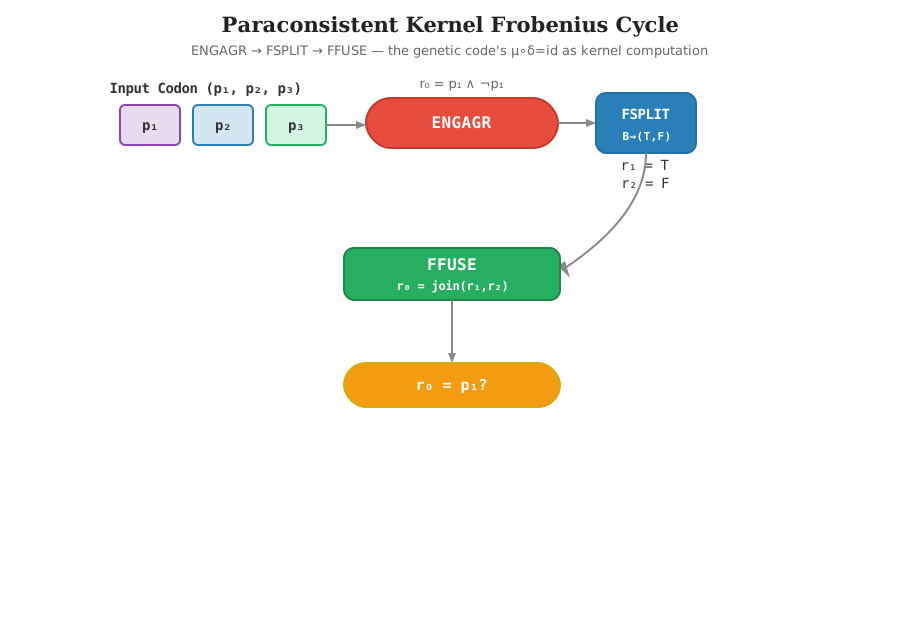
The paraconsistent kernel's Frobenius computation. Each codon undergoes the triple operation: ENGAGR (self-reference), FSPLIT (δ comultiplication), FFUSE (μ multiplication). The theorem ffuse∘fsplit = id IS the genetic code's μ∘δ=id.

Paraconsistent Kernel Frobenius Cycle ENGAGR → FSPLIT → FFUSE : The genetic code's μ∘δ=id as kernel computation Input Codon (p₁, p₂, p₃) p₁ p₂ p₃ ENGAGR r₀ = p₁ ∧ ¬p₁ FSPLIT B → (T,F) r₁ = T r₂ = F FFUSE r₀ = join(r₁, r₂) r₀ = p₁? ✓ Exact stratum: r₀ = p₁ holds exactly ✓ Split stratum: r₀ = p₁ modulo ℤ₂ wobble ✓ Stop codons (UAA,UAG,UGA): Ω boundary detected Theorem: ffuse∘fsplit = id for all four Belnap values The kernel's Frobenius invariant IS the genetic code's μ∘δ=id 17,280,000 / 64 = 270,000 : Crystal divides codon space exactly
04

The 20 Amino Acids: 8 Ground + 12 Promoted

Ground-layer AAs (Leu, Pro, Arg, Thr, Ala, Ser, Val, Gly) carry no primitive activation. 12 promoted AAs biject onto the 12 IG primitives (Ð, þ, Ř, Φ, ƒ, Ç, Γ, ɢ, ⊙, Ŧ, Σ, Ω), ordered by structural risk class.

The 20 Amino Acids: 8 Ground + 12 Promoted Ground-layer AAs carry no primitive activation. 12 promoted AAs biject onto the 12 IG primitives. Ground Layer (8 AAs) No primitive activation — kernel runs in base mode Leu (UUA, UUG, CU_ box) Pro (CC_ box) Arg (CG_ box, AGA/AGG) Thr (AC_ box) Ala (GC_ box) Ser (UC_, AGU, AGC) Val (GU_ box) Gly (GG_ box) + Promoted Layer (12 AAs) Each activates exactly one IG primitive Met Ð (Dimensionality) Trp þ (Topology) Cys Ř (Recognition) Tyr Φ (Parity) Phe ƒ (Fidelity) Ile Ç (Kinetics) His Γ (Granularity) Asn ɢ (Coupling) Gln ⊙ (Criticality) Asp Ŧ (Chirality) Lys Σ (Stoichiometry) Glu Ω (Winding) = 20 Amino Acids Primitive Activation Risk ■ Critical (Ð, Ŧ, Ω): Met, Asp, Glu ■ High (Ř, ⊙): Cys, Gln ■ Moderate: Trp, Tyr, Ile, His, Asn ■ Low (ƒ, Σ): Phe, Lys 8 + 12 = 20 Amino Acids = 16 × 4 / 3.2 = 64 / 3.2 Ground-layer AAs come in 8 exact boxes (32 codons). Promoted AAs occupy split boxes (29 codons) + 3 stops. The bijection is structural: 12 IG primitives ↔ 12 promoted AAs, ordered by primitive risk class.
05

Stop Codons as Ω Winding Boundary

UAA (Ω₀ Ochre), UAG (Ωℤ₂ Amber), UGA (Ωℤ Opal) form the Frobenius algebra's topological boundary. Each carries a distinct Ω winding class, detected by the kernel as a paradox in the Frobenius condition.

Stop Codons as Omega Winding Boundary The three stop codons are the Frobenius algebra's topological boundary (Omega winding number) UAA (N, F, F) = (U, A, A) Omega0 — Ochre Simple termination Minimal Omega value UAG (N, F, B) = (U, A, G) OmegaZ2 — Amber Conditional termination Selenocysteine readthrough UGA (N, B, F) = (U, G, A) OmegaZ — Opal Open/topological termination SelCys recoding possible B4 Triple Structure All three start with U (N = Neither) at position 1 Position 2 is always a purine (A=F or G=B): the kernel's paradox detection point Position 3 carries the Omega winding class Kernel Paradox Detection ENGAGR on p1 = N produces N- N = N FSPLIT on N returns (N,N). FFUSE returns N = paradox detected: r0 does not equal p1 The Frobenius condition fails constructively — this IS the termination signal Omega winding hierarchy: Ochre < Amber < Opal — increasing topological complexity
06

B₄ Lattice Mutation Paths

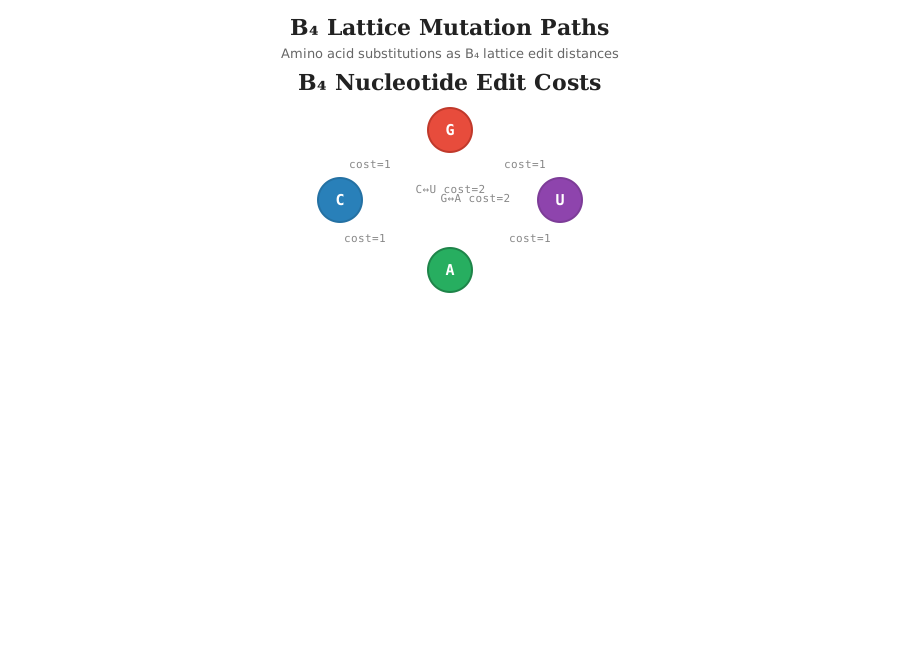
Amino acid substitutions analyzed as B₄ edit distances on the nucleotide lattice. Covering relations cost 1 (G→C, G→U, C→A, U→A). Cross-lattice jumps cost 2 (G↔A, C↔U). The Chimera Theorem governs composite edits across multiple primitive classes.

B₄ Lattice Mutation Paths Amino acid substitutions as B₄ lattice edit distances — from single-nucleotide to cross-stratum B₄ Nucleotide Edit Costs G C U A cost=1 cost=1 cost=1 cost=1 G↔A cost=2 C↔U cost=2 Example Mutation Cost Analysis Met (AUG) → Ile (AUA/AUC/AUU) Minimal path: AUG → AU⁝ (single-pos edit) B₄ cost = 1 (p₃: G→A, C, or U) No primitive change: Met (Ð) → Ile (Ç) Asp (GAU/GAC) → Glu (GAA/GAG) Minimal path: GAU → GAA (p₃: U→A) B₄ cost = 1 (single cover: U→A) Primitive change: Ŧ (Chirality) → Ω (Winding) Glu (GAG/GAA) → Phe (UUU/UUC) GAG → UUC: G→U + A→U + G→C Total B₄ cost = 3 (three edits) Cross-stratum: split → exact box Chimera Trap Detection Editing across multiple primitive classes triggers the Chimera Theorem: tensor(⊙₋, ⊙₃) = ⊙₃ Composite edits are tensorial, not additive Primitive Mutation Risk Classification Critical risk Ð, Ŧ, Ω — Met, Asp, Glu High risk Ř, ⊙ — Cys, Gln Moderate risk þ, Φ, Ç, Γ, ɢ Low risk ƒ, Σ — Phe, Lys