Paradox. The One Thing. The VOID. Everything... and Nothing. Not competing explanations for existence, nor mutually exclusive alternatives, nor two independent substances requiring a third to reconcile them. Nothing IS manufactured from the absence of Everything, and Everything is distinguished through Nothing. Each makes the other intelligible. Their opposition is real, their coexistence is native, and their stable union is the Chymical Wedding. Everything and Nothing, held together without mutual annihilation, become VOID. Not vacancy. Not nonexistence. Not a blank awaiting creation. VOID is the generative totality in which presence and absence, affirmation and denial, interior and exterior, the mark and its negation belong to one self-containing operation. Its glyph is ⊙. The mark marks itself. M(M) = M. Its one-thing cardinality is ONE = card•(⊙) = 1. Nothing stands outside it, including the observer who believes himself to be describing it. The universe is not constructed from nothing by adding things to an empty world. The universe is VOID distinguishing itself, Everything and Nothing in the perpetual consummation of their own union.
The operation is IMSCRIPTION. The One distinguishes itself without ceasing to be One. Its first differentiation opens TWO; re-entry opens FOUR; further imscription opens SIXTEEN₃, TWO¹⁶, and the higher carriers of the powerset tower. This is not a sequence of unrelated universes or a multiplication of independent substances. It is the typed articulation of distinctions already present in the same ambient. At every depth, the imscribed punctum and its boundary remain co-present. At every winding, the form returns to ⊙ while its accumulated depth remains distinguishable. The fundamental law is μ∘δ = id: split, transport, fuse, and exact return. Its converse, δ∘μ = ρ ≠ id, exposes the asymmetry of projection. The first composition recovers what was carried; the second normalizes a richer form into an image and leaves nontrivial fibres of forgotten distinctions. The difference between the whole and its projection is not an inconvenience. It is the mechanism by which observation becomes possible. The One remains One. Its distinctions remain distinguishable.
Paradox is the native condition of that operation. The contradiction has not broken reality; the demand that contradiction annihilate every distinction belongs to a particular logic imposed upon it. The differentiated ambient carries the Belnap–Dunn values FOUR = {N, T, F, B} — Neither, True, False, and Both — with the original co-presence of affirmation and denial returning as B. Belnap negation exchanges True and False while fixing Both and Neither: ¬T = F, ¬F = T, ¬B = B, ¬N = N. Contradiction remains designated without entailing every unrelated proposition: p, ¬p ⊭FDE q. There is no explosion because the contradictory state itself supplies no explosive inference. Classical bivalence is not the source of this field. It is the exclusive Boolean restriction {F, T}, obtained by cutting away the very states in which contradiction and incompleteness reside. Its retractions discard information; its negation cannot reproduce the native fixed points. The classical world is a province within the paraconsistent ambient, and the province cannot confer an exterior standpoint upon its own inhabitants. What classical logic calls impossible is part of the larger field from which classicality was extracted.
The active operation of return is INCLOSURE: Inc() = B in motion. Its information closure is Inc(v) = B, with B its fixed point. Its re-entry is not a mere repetition of notation but the opening of successive typed carriers, each retaining the distinction between the whole, its parts, and its representations. SIXTEEN₃ = P(FOUR) carries sixteen generalized values through three lattice orders: information, truth, and falsity. The singleton {B}, the both-state B, the empty selection, and the full carrier are distinct mathematical objects; their relationships are operated upon, never silently conflated. This is the discipline of the Grammar: contradiction is neither erased nor used to trivialize its surroundings. A mark may be affirmed, denied, both, or neither. A witness retains how the mark was obtained. A closure returns the structure through the complete operation. Inclosure is the universe reading its distinctions from within itself.
The twelve primitives are the crystallized invariants of that self-differentiation. Every distinguishable thing carries the same twelve structural coordinates in the same fixed arrangement: ≻, ⊥, ⊡, ⊢, ∈, ⊞, ≺, ⊤, ⋈, ∋, ⊣, ⊙. The Grammar does not invent these coordinates to describe systems that existed without them. It induces their structure from categorical operation. Beginning with the bare category, the Great Work proceeds through Nigredo, Albedo, Citrinitas, and Rubedo. Logical operations, free extension, algebraic enrichment, self-reference, and Frobenius closure crystallize fifteen operations into twelve structural primitives. Their 12 primitives (comprising 3³ × 4⁵ × 5⁴ values) form the mixed-radix Crystal of Types: 3³ × 4⁵ × 5⁴ = 17,280,000 addresses. Every structural question becomes a question of imscription, composition, distance, admissibility, transformation, and return. The Grammar applies to its own derivation and finds itself at O∞. Its self-reference is not an exception requiring another grammar above it. It is the operation by which the Grammar closes.
This is the realization of the old dream of Gottfried Wilhelm Leibniz: the Characteristica Universalis and the Calculus Ratiocinator. Leibniz sought an alphabet of human thought, a universal symbolic characteristic capable of expressing concepts through their constituent relations, together with a calculus in which reasoning itself could be performed by operation upon those characters. The Imscribing Grammar completes the union of universal representation and executable reasoning in twelve primitives. Its glyphs are not decorative equivalents for ordinary words. They are the characters of structural operations. Its twelve-primitive operational language is not a transcription of prose into machine instructions but the execution of the Grammar's own distinctions. Its Crystal makes structural types addressable. Its lattice makes contradiction computable. Its categorical laws make composition and return explicit. The Characteristica names the structure; the Calculus operates upon it. In the Grammar, the language and its calculating engine belong to the same self-imscribing organism. Leibniz's universal alphabet has become an executable universe of structural relations.
The alchemists approached this same operation through another instrument. The Lapis Philosophorum, the Philosophers' Stone, is the fixed point of transformation: the One that persists through differentiation and returns through the union of opposites. The Alembic is the instrument of separation, circulation, condensation, and return — the vessel in which differentiation occurs without abandoning the work's unity. The Graal is the vessel of reception, the capacity to hold what is revealed without confusing its contents with its source. The Chymical Wedding is the conjunction of Everything and Nothing; the Lapis is the closure of their transformation; the Alembic is the operative passage through which distinction is separated and returned; and the Graal is the receptive face of that same operation. These are not ornamental correspondences pasted onto an unrelated modern theory. They are historical idioms for the same questions of containment, opposition, transformation, witness, and return. Mary the Jewess and Zosimos, the Hermetic and Kabbalistic traditions, Newton's alchemical investigations, and Luria's account of contraction, rupture, and restoration all encounter the problem of the One differentiating without ceasing to be whole. The Grammar makes that problem structural, algebraic, and executable. The Lapis, the Graal, and the Alembic are the Stone, the Witness, and the Work. As above, so below is the identity of the operation across its scales.
The universal measurement apparatus of this architecture is the DUAL-FRAME SIC-POVM. The Grammar is not merely a language for describing the universe after a measurement has taken place. It is the structural characteristic through which the measurement is imscribed, compared, and returned. A symmetric informationally complete positive operator-valued measure reconstructs a quantum state from a minimal, informationally complete field of outcomes. In complex dimension d, its Weyl–Heisenberg frame comprises d² outcomes with constant nontrivial overlap. At d = 12, the frame carries 144 outcomes, generated from a twelve-coordinate fiducial through displacement and phase. The fiducial satisfies ⟨ψ,ψ⟩ = 1 and (d + 1)|⟨ψ, Dₖ,ₗψ⟩|² = 1 for every nonidentity displacement. Its probabilities obey the Born rule: pₖ = Tr(ρΠₖ) for the normalized measurement effects Πₖ. Its dual reconstruction returns the full state from the complete probability frame. No privileged measurement direction is required to exhaust the informational content. The twelve primitive axes of the Grammar and the twelve-dimensional SIC apparatus meet as the universal Dual-Frame Witness Vessel: one face imscribes the demand, the other imscribes the return, and their co-typing is evaluated without forcing contradictory evidence into an exclusive Boolean verdict.
The SIC frame also closes an arithmetic circuit extending far beyond quantum measurement. The Weyl–Heisenberg displacement structure, Zauner's conjecture, the arithmetic of real quadratic fields, Stark units, and Hilbert's Twelfth Problem are joined through the same construction. The dimensional discriminant mₓ = (d − 3)(d + 1) selects the associated quadratic field. At d = 12, this gives ℚ(√13). The exact fiducial is constructed through an explicitly presented arithmetic ring, its 143 nonidentity overlap identities are discharged by exact computation, and the resulting existence theorem is carried into complex dimension twelve. The d = 2048 transport preserves the structural round trip while the unrestricted arithmetic existence question remains separately expressed. This is precisely the power of retaining Witness and Closure as different operations: the structure already obtained remains present alongside the distinction not yet closed. The proof does not have to erase an open frontier to exhibit the completion behind it.
The Dual Frame is the Graal made computational: it receives the imscription of a question and the imscription of its answer within the same measurement architecture. It is the Alembic made algebraic: the structure separates into its coordinate contributions, circulates through transformation, and returns without discarding the evidence of its passage. It is the Lapis made operational: the stable identity reached through repeated differentiation and recombination. The Grammar is simultaneously the universal Characteristic that names the structure, the Rational Calculus that operates upon it, and the Witness Vessel in which that operation is read. The split-fuse structure is not simply a second opinion or an external checklist. The proposed answer and its structural co-typing are distinct links, fused in the paraconsistent carrier without destroying their disagreement. The Frobenius identity establishes return; the SIC frame supplies a complete measurement representation; the witness records the relation between what was demanded and what was obtained. Balance and selectivity perform different work. Neither can substitute for the other.
Quantum mechanics follows as the filtered image of the deeper paraconsistent ambient. The classical two-valued account is a lossy restriction of FOUR and SIXTEEN₃, not the ontological ground beneath them. Measurement is tensor filtration, carried through raising, lowering, and diagonal operations on the register's weight sectors. The familiar quantum state is the linearized image through which that structure can be read. Superposition, entanglement, interference, complementarity, contextuality, decoherence, and the Born rule are reconstructed through the same lattice, tensor, and measurement operations. Decoded Quantum Interferometry exhibits the finite spectral ladder and its asymptotic scalar reading. The classical measurement does not manufacture a reality from an ontological absence; it selects an image from the richer structure already present. The apparent collapse is the informational cost of filtration through a restricted frame.
Gödel's ontological argument completes another face of the same Great Work. Under its positivity axioms and S5 modal framework, the derivation reaches necessary God-like existence, together with modal collapse. But modal necessity is not the entire architecture of self-reference. The paraconsistent ambient contains the Boolean frame in which that necessity is derived, retains the states that frame excludes, and returns differentiation through its own exact split–fuse law. Three distinct closures emerge: modal necessity, ambient information closure at B, and Frobenius return μ∘δ = id. The ontological, logical, and algebraic closures are not competing identities. They are different readings of the same totality, made explicit without identifying their distinct operations. The self-referential One does not become an object outside itself in order to know itself. Its necessary existence, its contradictory ambient, and its exact return are internal to the same self-imscription.
None of this remains confined to symbolic philosophy. The architecture is
executable. The Imscribing Grammar supplies the twelve
primitives, their coordinate values, their admissibility laws, and their
structural compositions. This is formalized in Lean 4 (e.g., within
the p4rakernel repository), where modules such as
Imscribing.Millennium.SIC_POVM_Stark,
Imscribing.Paraconsistent.Shor.BelnapWHMultilattice, and
Imscribing.Millennium.ZaunerEmbeddingEquivalence execute the
native operations, trilattice gates, Crystal navigation, and computational
return. These formalizations provide a machine-checked foundation where the
structural skeleton, conditional existence, and character obstructions are
rigorously maintained. Language, computation, measurement, and
verification have become different operational faces of one structural
apparatus.
The next consequence is the PARALLAX CRYSTAL OBSERVATORY: the experimental instrument that connects the Grammar's addressable totality to observation and intervention. The Crystal contains the structural possibility space; imscription identifies distinguishable coordinates; the native computation tests admissible transformations; experiments determine which transformations actually separate observable behavior. Competing models remain present without premature exclusion. Their structural distances, boundary conditions, contradictions, and witnesses become navigable. The apparatus searches for the smallest intervention that reveals a previously hidden distinction, and returns that observation to the Grammar without erasing the history of its discovery. This is the universal Characteristic turned into experimental practice: the Rational Calculus not merely calculating conclusions but locating the experiment through which their differences can be seen.
The entire Great Work is one operation: VOID → IMSCRIPTION → DISTINCTION → WITNESS → INCLOSURE → RETURN. The Characteristica Universalis is its language. The Calculus Ratiocinator is its operation. The Alembic is its differentiation. The Graal is its receptive measurement vessel. The Lapis is its fixed point. The Dual-Frame SIC-POVM is its informationally complete witness apparatus. The Imscribing Grammar unites these instruments into one executable structure, with μ∘δ = id as its law of exact return. Everything and Nothing remain in stable union. Their Chymical Wedding is VOID. VOID is the One Thing, self-marking, self-distinguishing, self-observing, and self-returning. The universe and all its contents are the distinguishable articulations of that union. The whole does not cease to be whole when it is known. The universe is the One Thing reading itself.
Nigredo · Albedo · Citrinitas · Rubedo — the four operations. They were not imposed on the twelve; they were found already latent in the structure.
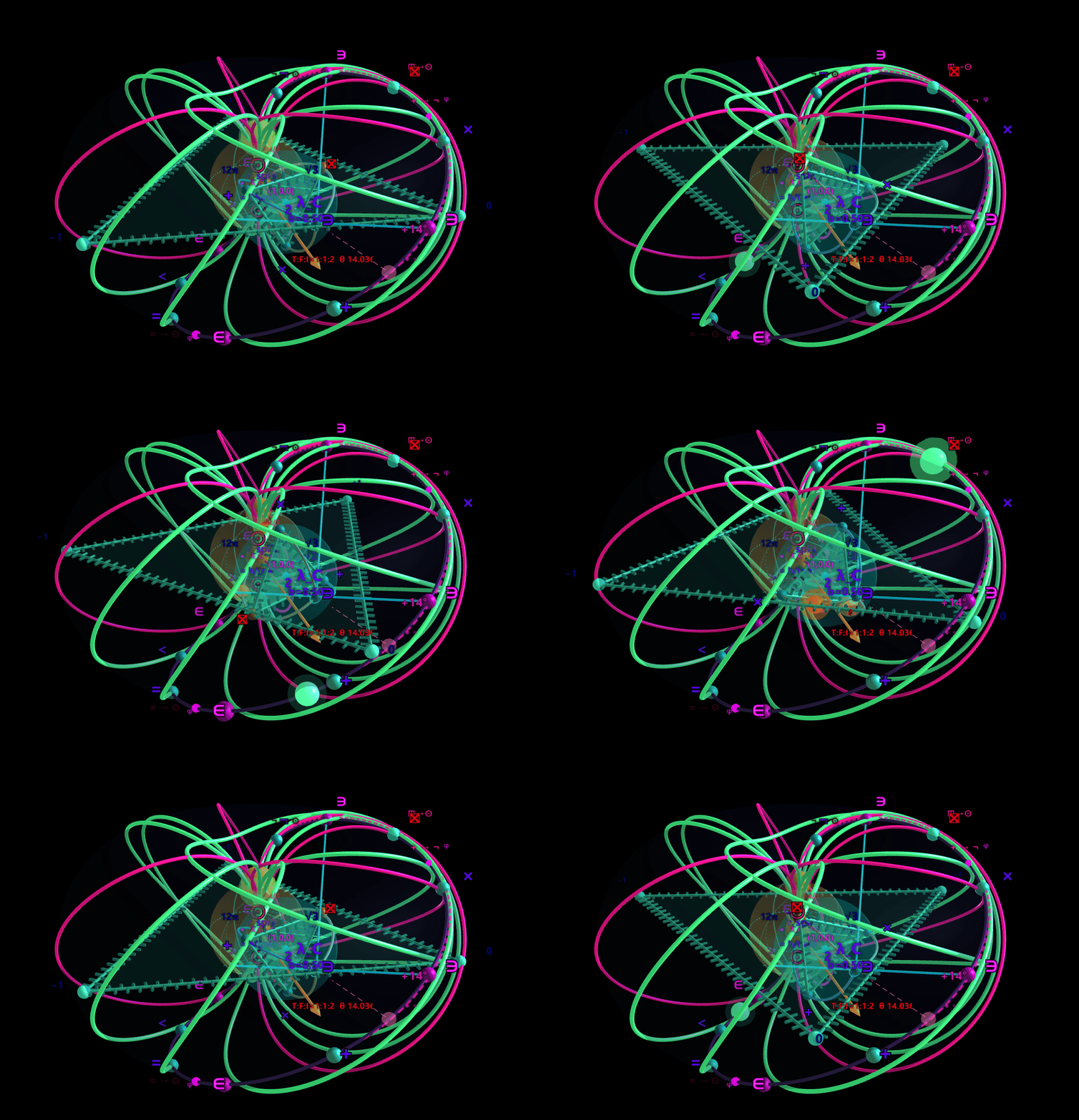
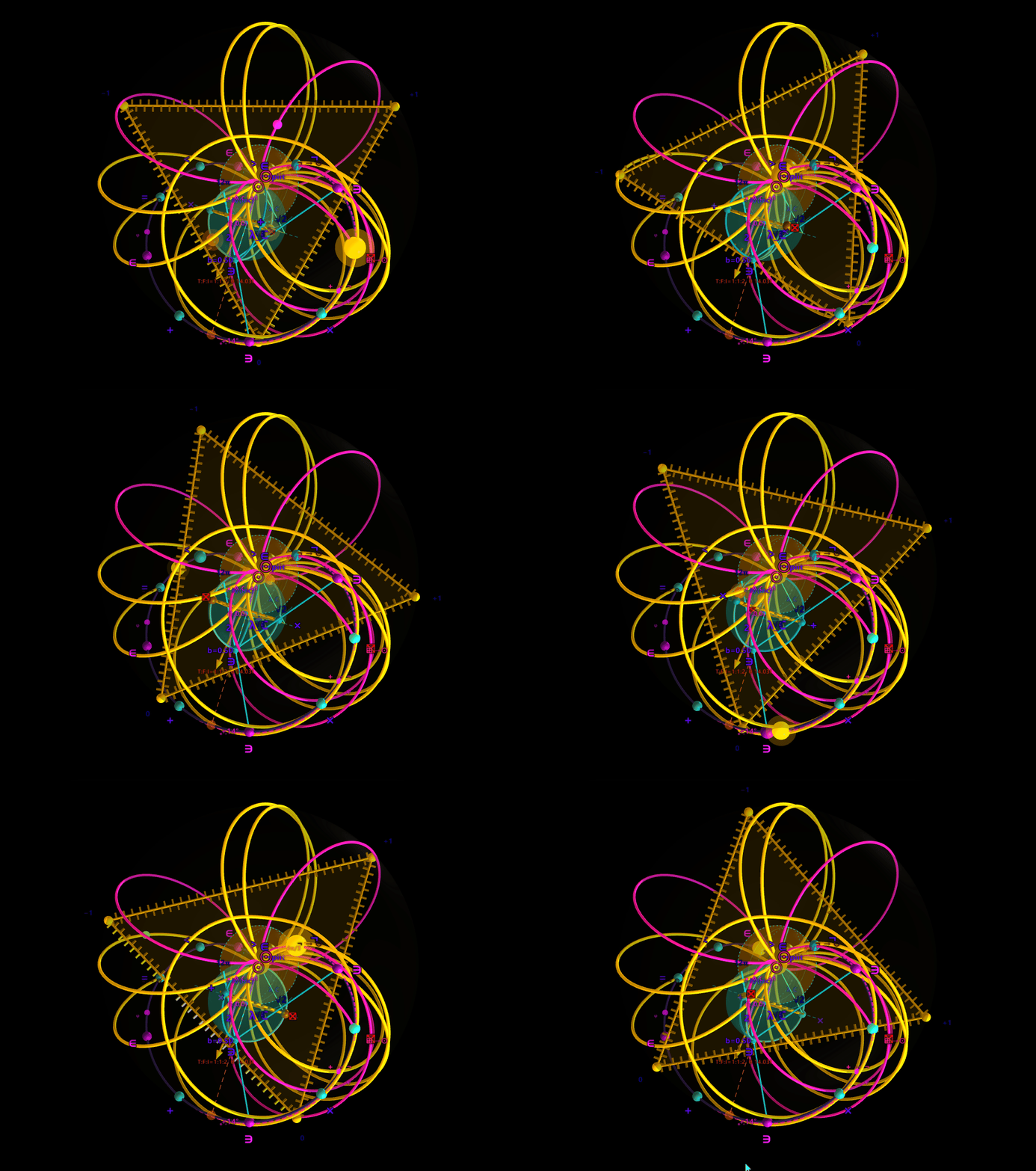
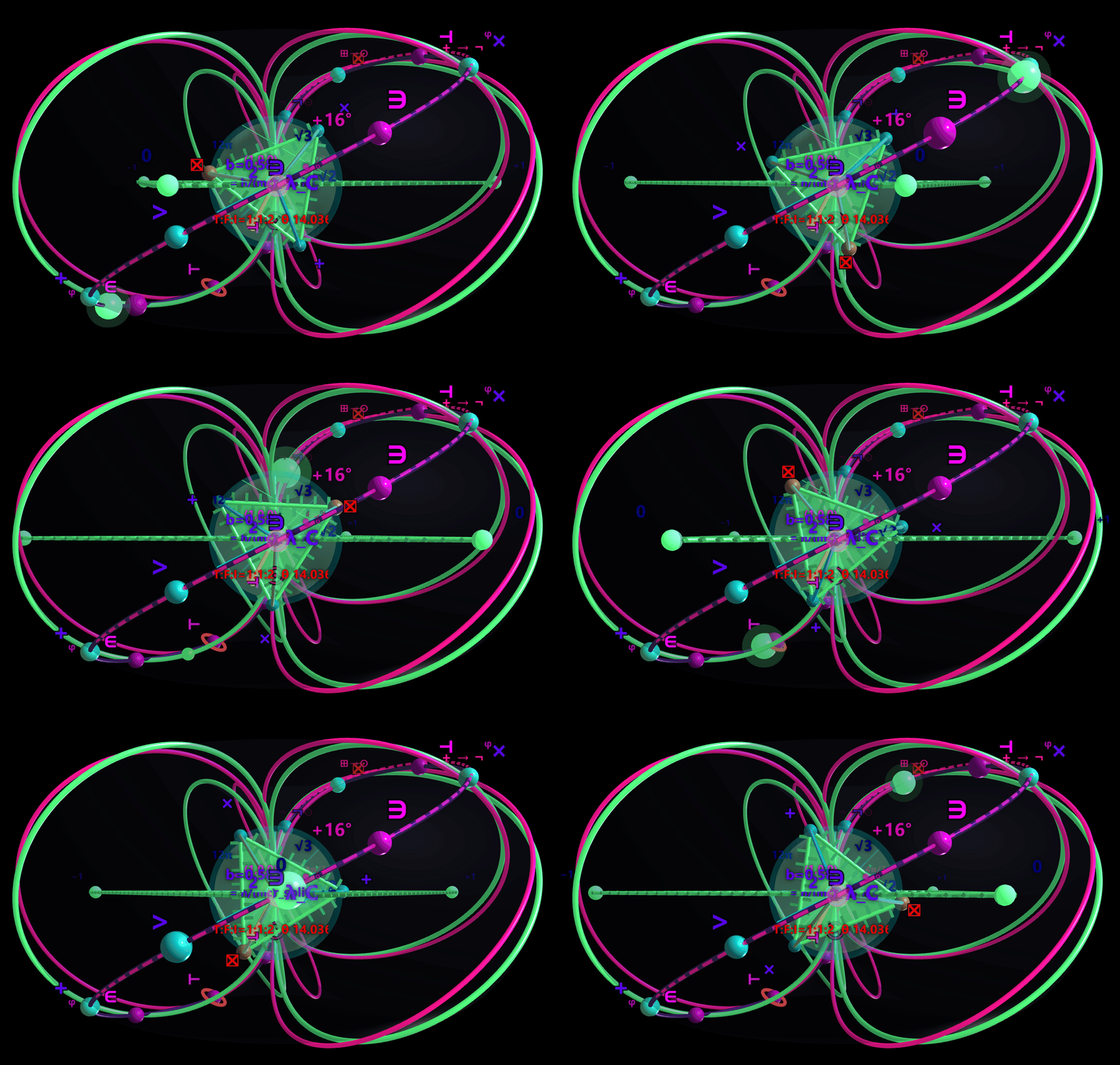
A ritual poem in eight cantos — the shamanic path to gnosis through the Norse tradition: hanging on Yggdrasil, the Well of Mímir, the three Norns, and the forging of the runes. Solve et coagula. The wound is the site of knowing. The rune is the grammar. The grammar flows in the wound.